Saturday, 29 September 2012

Kaosarn, St John's Hill: Guaranteed Good Times


‘Why don’t we go to Kaosarn instead?’ The text from wine-botherer Ruth Ford read a year or so ago when I suggested we visit some upstart of a restaurant in Brixton village. ‘I’ve heard not-great things about ___, but Kaosarn will be guaranteed good times.’

We didn’t end up going for some reason or another, but that epithet stuck with me. In my head, Kaosarn became the unfaddy, honest restaurant we all needed round the corner. 

Oh the excitement, the unfettered joy we felt when we heard that Kaosarn was opening on St John’s Hill in Wandsworth. The lead came from a tweet from Luke Mackay that the much-loved Thai canteen was making its way westward, expanding from its Brixton home closer to my home. 


St John’s Hill has had a strange relationship with restaurants - so often has some unsuspecting and naive budding-restaurateur arrived and fled within the year. St John’s hill is no Northcote Road - sans gloss and prams, but it’s lately had an influx of good things happen to it. Joining the rather brilliant Fish Club, French deli and Chinese Good Earth Express were Ben’s Canteen, which recently hosted a dinner from Roganic’s ex head-chef Ben Spalding, and two new popular drinking establishments - the Plough and Powder Keg Diplomacy

Thrown into the mix is Kaosarn, the Thai canteen with the cult following. And the ‘Hill’ has been screaming - aching, in fact - for a place like this. 

Opening today, it was manned by a full staff of efficient ladies and led by the industrious Gisele. Much more of a restaurant than the cafe in Brixton, the space is roomy and light (there’s a back room that can be hired for private functions as well), with tables lit intimately with candles. The menu is so extensive (the first page already divided into starters, salads, noodles and soups) we had to reign ourselves in. Armed with four bottles of Chang beer from the offie across the road, we were ready. 
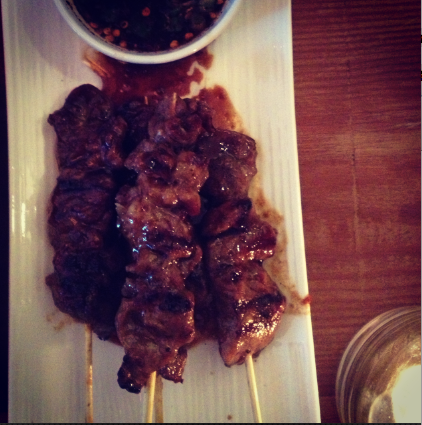

On Gisele’s recommendation we started with moo ping - skewers of tender pork, sticky with sauce and dark and shiny with the caramelisation of palm sugar. It was a confident and competent start to the meal. 


The tom kha gai - chicken pieces in a hot coconut soup - was a compact explosion of flavours - laced with chilli and lemongrass and flavoured with slices of galangal and plump mushrooms. 


Hot tiger prawns and bamboo with red curry paste had the lick of Thai basil and was sprinkled with Thai aubergines and green peppercorns. The menace of red chilli slices thrilled through this stunning dish - our favourite and the one that will draw us back. (Pad prig gang on the menu)


Yum woonsen - warm glass noodle salad with prawns, minced pork, peanuts, chilli, coriander, red onion and spring onion was light yet satisfying. The balance of sweet sugar with the tang of fish sauce was right on. I could eat bowls and bowls of this. 

Though it was the first night, there were no nerves, no cock-ups and by seven o’clock was almost full. Kaosarn will live up to its Brixton reputation and draw the food-loving crowd to St John’s Hill, light up nights out and provide what they’re known for: guaranteed good times. 

Kaosarn on Urbanspoon

Square Meal


Kaosarn
110 St John’s Hill
SW11 1ST
020 7223 7888

BYO, cash only (cash machine across the road), takeaway

Sunday, 5 August 2012

The Gilbert Scott: A thoroughly British affair


Evangelists occupy the Gilbert Scott restaurant. This is no place for indifference. The security guard chats for twenty minutes about the wrought iron from Coventry with Olympic fervour next to the now-famous staircase in the Spice Girls’ Wannabe video. The front of house enthuses about Marcus Wareing who pops in at least once or twice a week to run the team here with head chef Oliver Wilson. A grail for history-lovers, artists, models and academics who take refuge from the British Library, the newly refurbished St Pancras renaissance hotel (which houses the restaurant) is an ode to the skill and splendour of British architecture and industry. 
So prescient is the personality of the St Pancras Renaissance that you almost feel short-changed by the simplicity of the bar and dining room. Unfairly so, as the ceiling is cathedral-high, the marble twinkles and is splendidly grand and altogether impressive. It’s shiny and polished and, quite frankly, splendid. 
It’s such an exhibition of the best of home manufacturing and design that one can only wonder about the food. 
It would follow that Marcus Wareing seems a good fit, after all, he is a Lancashire craftsman who evolves already staunchly British dishes to become iconically British. This is the Wareing whose care has won Michelin stars for the likes of Petrus and brought Prue, Oliver and Matthew to their knees with the wibble of his custard tart in the first ever Great British Menu.

And so a charming evangelist at front of house takes us to the bar, where the evangelist barman serves us up a spiced virgin mary (for my pregnant friend Claire who’s saving her drinks for the main)...


...and an a-pear-itif cocktail (Pear Grey Goose, Sipsmith gin, cucumber, elderflower), fresh with that taste of English gardens. A most elegant drink with the cool of the cucumber wrapped round an ice cube in a coupe glass.

We’re taken through to the impeccably elegant dining room, and dinner begins. Claire’s Portwood Farm asparagus are fat and sweet, accompanied by a burnt butter hollandaise. They are unspectacular but wholly delicious. 

My bone marrow with snails is a quite perfect dish. Juicy snails, deeply dark in taste and look, sit affably on the jelly of the marrow. Spooned onto toast soaked through with garlic butter, it’s almost creamy in its richness and overall, exquisite in conception.

We take a quick break to sneak down to the kitchen table, a front-row view (for up to ten people) of the cool mechanics of the steam-lined kitchen. The curious can also peer at the wines kept behind the table. 

Back up to our table, our mains are ready to serve. My rump of veal is a solid symphony of flavours - wild garlic and sage accompany the pink, surprisingly meaty and juicy veal, lifted by the sweet of plump roasted onions. 

Claire’s coral-pink scottish sea trout is a succulent and slim fillet under a blanket of crisp skin. It’s a well-executed dish. We expect something cold and salady from our side order of peas, lettuce and lovage but with the latter wilted and thickened with a touch of cream to mellow its pungency, it is a welcome surprise. 

For pudding we have Mrs Beeton’s snow egg, a variation of the French dessert ile flottante - poached meringue atop a light and cold custard or creme anglaise. It is slightly ‘ile’ heavy (I'd love more custard), but cleverly lined with marmalade in the middle and the smooth almost foam-like richness is cut through with the crunch of caramelised almonds. 

Claire’s warm chocolate cornflakes makes up for all those times you were deprived pudding as a child; the dessert is almost unforgivably rich and a nod to the glory of the chocolate crispy cake. 
There is a sort of humour and pride that laces the Gilbert Scott menu; where else outside of Cumbria will Kendal mint cake be an ingredient? I would certainly love to pop in for a peanut butter ice. Either way, I do believe for those who arrive in straight from the Eurostar, the Gilbert Scott should be the first stop for a happy and glorious view of London town. By the end of the meal we are satiate, evangelistic, and terribly proud that the British are such devilishly good cooks. 

The Gilbert Scott
St Pancras Renaissance Hotel
Euston Road
London
NW1 2AR
020 7278 3888

Helena and Claire were guests of The Gilbert Scott.
The Gilbert Scott on Urbanspoon

Monday, 16 July 2012

What to drink with Bavette, by Ruth Ford

Must drink..! 
An irregular column from wine-botherer Ruth Ford 

...to accompany an ode to the skirt steak (bavette)

Bavette at Duck Soup in Soho

'Sometimes when you taste a red wine it can leave a really dry sensation in your mouth, as if you've just sipped some tea in which the tea bag has been sitting for too long. The feeling is round your gums, at the back of your tongue and on the roof of your mouth, and it is sometimes described as chalky, bitter, and astringent. All these sound like bad things that shouldn't be there in your glass of wine, but in fact they come from something called tannin, which is a chemical compound found in wine. In some wines the levels of tannin are higher than in others, and that's when you get the sensations described above. 


Tannin comes from grape skins, pips, and stalks, and sometimes from oak ageing. It's extracted during the wine-making process, when the grapes are pressed and then when the grape skins are left in the juice for a while to extract colour and flavour. Some grapes have more tannin than others, and also the wine-maker can decide how much tannin they want to extract for the style of wine they want to make. 


Tannin provides 'backbone' to a wine - it gives it structure and stops it from being too soft or one-dimensional. It's also a natural preservative which helps a wine to grow old gracefully. It gives a wine complexity and interest of flavour. However, sometimes it can make a wine difficult to drink on its own. And that's where chewy red meat comes in. Chewing meat whilst drinking a tannic red will help to break down the tannins in your mouth so the other flavours in the wine - fruit, spice, etc. - come to the fore and are complemented by the tannin rather than overpowered by it. 


Bavette has a fantastic gamey, intense flavour and texture that will help to sort out even the most challengingly tannic wine. Some classic examples of tannic wines include Barolo, young Bordeaux and Chianti, and Cahors from the South of France. If you've tried a wine before and thought you didn't like it because of the sensations described above, why not try it again with Helena's bavette recipe? You might be pleasantly surprised at how the wine changes when paired with the delicious juicy meat.'


Read other posts by Ruth
Follow Ruth on Twitter


Thursday, 10 May 2012

Nut butter and Butternut Squash soup with Salami Crisps


 Butternut Squash Soup with a secret ingredient...

It's the month before Christmas. A month filled with half-asleep sleeps from the run of festive parties. I begin to expect the regular full-moon interruptions from the boy T, the knocking into doors because he bends over funny as he unties a shoelace, a cheeky stumble  before just making it to the kitchen and downing pints of water in attempt to claw back sobriety. Probably punctuated with a carol. 
One of these nights I’d left a butternut squash soup open on the stove to cool. T comes back in normal fashion (after dad-dancing through Shadow Lounge jaegerbombs with his work team). Irregular drunken steps. He falls into the kitchen. Silence. Then all I hear is the eruptive ‘Oh my God, wow!’ 
It's the soup. He's just tasted the soup. He goes back for more. 


It's a premiere reaction. Had I ever had that response to my soup-making before from anyone, I'd be sweating at the stove making stock more often. 


The soup is cooked up again this springtime (albeit drizzly) week because the suggestive marrow repeatedly pops up in my veg box. And it's even better than I remembered - creamy without having an ounce of cream, sweet without added sugar. Any eater expecting your standard squashy soup is invariably surprised at first taste with the deliciously deep flavour of peanut butter Americana. It's a soup that's savoury and sweet, spiked with chilli-hot goodness, fresh with coriander and lime, lifted with the mere whisper of ginger. And with a topping of crisp salami, a steaming bowl of this moreish blend is pure perfection after a hard day's (or hard night's) work.  

Nut butter and Butternut Squash soup 

Pre-soup. The ingredients

1 butternut squash - peeled, seeded and diced into small cubes
Butter
1 large onion or 2 small onions finely chopped
1 red chilli chopped
Knob of ginger - thumbsize, grated
1 large garlic clove - finely chopped
1 litre veg stock/chicken stock
3 heaped tablespoons peanut butter
Juice 1 lime
Big handful coriander
6 Milanese salami slices (optional)
Salt and pepper
Salami crisps
In your soup pot (my trusty cast iron number) slowly fry salami slices on both sides until crisp - it will fry in its own fat so you don’t need to add any oil. Set aside.
In the same pan, add some butter and the onion, and fry on a low heat for five minutes until translucent. Add the ginger, chilli and garlic, and fry for a minute or two. It should be gorgeously fragrant. 
Add the squash and fry for at least a good 10-15 minutes on a low heat until they become slightly soft and frayed round the edges. Season with salt and pepper. 
Pour in the stock, bring to the boil, then turn down the heat and simmer for 20 minutes partially covered with the lid. Before taking it off the heat, add the peanut butter and mix until dissolved. 
Pour into a blender (you might have to blend in batches), and throw in the bunch of coriander too and the lime juice. 
Blend until smooth. Pour back into the pan to gently heat back up again.
Serve with the salami crisps and a cheery sprinkle of chopped coriander.

Second helpings. Grilled fennel dressed with lemon in the background

Sunday, 22 April 2012

Ode to the Skirt Steak: Recipes and Where to Eat it


I love steak. So much so that I’ve belonged to a steak club for over five years, once ate steak five times in one week and still brazenly cook it in order to make friends. I remember being unable to afford a full three-courses at Hawksmoor when it first opened, but going to steak club and spanking £45 just on a juicy rib eye and absolutely nothing else. That’s how much I love steak. 


I’m a fan of the textured cut - one with a bit of chew and packs a meaty flavour punch. And so I introduce one of my favourite cuts - the skirt steak or bavette. It’s a cheaper cut (at one butchers the fillet is £45/kg, whereas skirt will be about £14.50/kg) but no less inferior. It’s a flat steak with beautiful marbling and takes flavour and marinating well (Anthony Bourdain recommends it grilled over an open fire of dried grape vines or good wood) and benefits from the smokiness of a Josper grill (like Les Deux Salons near Covent Garden). 
Bavette with Green Sauce at Duck Soup, Soho
You’ll find it on many a menu in London - I've seen it gracing Galvin's and Vinoteca's. Most recently, I ate one at Dean Street’s Duck Soup - sliced into ribbons and lifted with green sauce and served with sumac-sprinkled new potatoes and wilting wild garlic. 


But this is the easiest thing to cook at home. I find there’s nothing quite like a potter round the butchers and bringing home that precious, vermillion and marbled slab of meat, and unwrapping the paper like a present. The Ginger Pig’s skirt is second to none but we’ve had great ones from our local butcher down on the Northcote Road. 

Because it’s a coarse steak, it’s fit for the extremes of flash-frying or slow-cooking. I’ve not tried the slow-cooking before largely due to impatience (why wait 3 hours for something that takes five minutes?) So instead here are a few quick recipes on what to do with this magnificent cut. 
A few things to do with a skirt steak
How to cook the steak
Leave the steaks out so that they are room temperature. Lightly oil and season both sides liberally just before you’re going to cook it. Heat a flat-bottomed pan until smoking hot, and sear the steak on both sides for literally two minutes one side, a minute and a half on the other (I put my timer on). Do not be tempted to move the steak around in the pan. Leave to rest for 5 minutes.
With shallots
In the same pan, with the steak juices, heat up some more oil and cook finely chopped shallots with a sprinkling of sugar to caramelise and salt on a lower heat for 5 minutes. When a glorious brown, sprinkle on top of the steak. 
With garlic and parsley butter

Make a garlic and parsley butter about an hour or two before by mixing butter with finely chopped parsley and half a clove of crushed garlic. Roll into a sausage, wrap with clingfilm and put in the fridge to firm up. When ready to serve your steak, slice disks of butter, take the clingfilm off, place atop the unsliced steak and let it melt in the residual heat.
Steak sandwich


Steaks on the Japanese barbecue soon to turn into...steak sandwiches


Make a steak sandwich with a healthy smear of Tracklements horseradish and onions. 
(Fantastic and quick for entertaining as we did here on the Japanese barbecue)

Please do let me know if you have any more bavette recipes (more excuses to cook steak). 


Wednesday, 28 March 2012

Green Mango Salad

I love the youth of a green mango salad. It’s a salad fresh and shouty, foolish and sweet as a wet-eared adolescent who’s just emerged from the flush of spotty teenagehood. It’s the taste of freedom the first time you’re away from home, unbridled, yet still innocent in its unripe firmness.

Am I getting carried away here? Perhaps it’s because I’m faced with the twinge of a dicky hip, yearning for my salad days.

But this is a seriously good salad. That taste of crunchy mango evokes joy. Laced with the sour of limes, salt of fish sauce and sweetened with palm sugar, the flavours meld in delicious concord. Throw in the spike of a birds-eye chilli, and you’re asking for an exquisite kind of trouble as Leo diCaprio did in search of The Beach.

Strictly speaking, this is a Thai side salad. But this is my version (that is - not the beacon of authenticity). I know I should julienne rather than grate the mango, introduce the salt tang of shrimp paste/dried shrimp etc. etc. But this is a fifteen minute throw-together that is so moreish, ladlefuls will be eaten before you’ve even left the kitchen.

Top tip? Make more so that you can eat more.


Green Mango Salad Recipe

(serves 4 a a side salad, 2 as a main meal if you’re adding prawns/chicken)

2 x unripe mangoes (with yellow hard-ish flesh rather than orange) - peeled then grated
2 large handfuls of coriander - finely chopped
3 or 4 spring onions - finely chopped
1/2 - 1 red birds-eye chilli - seeds and all (to taste)

Dressing - mix together first
3 tablespoons fish sauce
Juice of 1-1.5 limes
1 tablespoon palm sugar (use brown sugar if you don’t have palm sugar)


Very simply - mix everything except the dressing ingredients together and watch the vibrant colours clash.

Add the dressing and mix well.

Add grilled prawns or chicken if you fancy - it really is the best garnish.

Sunday, 12 February 2012

New Leeks and Old Leeks: Two Recipes

Leeks with lemon and butter - half with a coating of cream cheese.
Recipe below

I’m running out of things to do with the leek. This is usually a problem confined to the carrot (a guaranteed muddy staple from Riverford), but this year the allium just keeps popping up, like an annoying but affectionate child, in my veg box.

So to use up the old leeks (almost two week old bendy things), the order of the day is a big vat of Nigel Slater’s leek and parmesan soup - once made, stored in the freezer and to be brought out on grey days like these. Sometimes I warm it up gently and drop in small cubes of double gloucester cheese that will melt in the residual heat so glorious yellowy-orange goo will grace each spoonful.

And yesterday, a new batch of leeks arrived - alert, erect and standing to attention. Little needs to be done with them - a quick fry will keep their sweetness and a slight crunch. A gorgeous lunch for one.

New leeks: with Butter and Lemon

So, after a cursory wash, and a rough chop of two leeks into thick rings, melt a slice of butter until foaming in a hot frying pan, and throw the leeks in. Coat the rings in butter, and leave to fry on high heat - only stirring occasionally - you want the leeks to catch and brown at the edges. When they’re just cooked (but still crunchy), squeeze lemon, season with salt and eat immediately. For a treat, spoon in cream cheese - it’s totally unnecessary but so delicious.


Old leeks: Nigel Slater’s velvety soup with Parmesan

Melt a slice of butter, and gently soften 3 leeks chopped into rings in a covered cast iron pan for 20 minutes. Add a peeled potato chopped into chunks, and cook for another five minutes. Add leftover Parmesan cheese rinds, and pour in 1.5 litres of veg stock. Season, then leave to bubble gently for under an hour, leave partially covered.

Take out the cheese rinds, (get as much Parmesan as you can from them), and blend until smooth. Add whatever grated cheese you would like in it, reheat and serve with crusty bread.

Adapted from Nigel Slater's the Kitchen Diaries

Previous leek risotto recipe here.