Showing posts with label RUTH FORD.. Show all posts

Saturday, 29 September 2012

Kaosarn, St John's Hill: Guaranteed Good Times


‘Why don’t we go to Kaosarn instead?’ The text from wine-botherer Ruth Ford read a year or so ago when I suggested we visit some upstart of a restaurant in Brixton village. ‘I’ve heard not-great things about ___, but Kaosarn will be guaranteed good times.’

We didn’t end up going for some reason or another, but that epithet stuck with me. In my head, Kaosarn became the unfaddy, honest restaurant we all needed round the corner. 

Oh the excitement, the unfettered joy we felt when we heard that Kaosarn was opening on St John’s Hill in Wandsworth. The lead came from a tweet from Luke Mackay that the much-loved Thai canteen was making its way westward, expanding from its Brixton home closer to my home. 


St John’s Hill has had a strange relationship with restaurants - so often has some unsuspecting and naive budding-restaurateur arrived and fled within the year. St John’s hill is no Northcote Road - sans gloss and prams, but it’s lately had an influx of good things happen to it. Joining the rather brilliant Fish Club, French deli and Chinese Good Earth Express were Ben’s Canteen, which recently hosted a dinner from Roganic’s ex head-chef Ben Spalding, and two new popular drinking establishments - the Plough and Powder Keg Diplomacy. 

Thrown into the mix is Kaosarn, the Thai canteen with the cult following. And the ‘Hill’ has been screaming - aching, in fact - for a place like this. 

Opening today, it was manned by a full staff of efficient ladies and led by the industrious Gisele. Much more of a restaurant than the cafe in Brixton, the space is roomy and light (there’s a back room that can be hired for private functions as well), with tables lit intimately with candles. The menu is so extensive (the first page already divided into starters, salads, noodles and soups) we had to reign ourselves in. Armed with four bottles of Chang beer from the offie across the road, we were ready. 


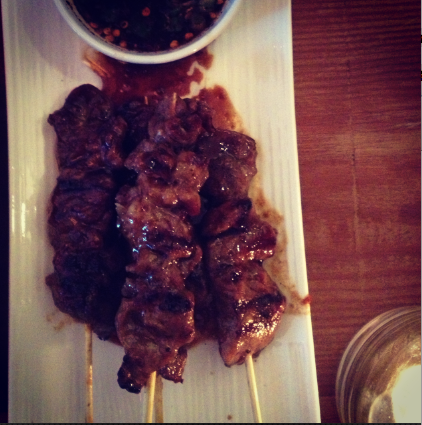
On Gisele’s recommendation we started with moo ping - skewers of tender pork, sticky with sauce and dark and shiny with the caramelisation of palm sugar. It was a confident and competent start to the meal. 


The tom kha gai - chicken pieces in a hot coconut soup - was a compact explosion of flavours - laced with chilli and lemongrass and flavoured with slices of galangal and plump mushrooms. 


Hot tiger prawns and bamboo with red curry paste had the lick of Thai basil and was sprinkled with Thai aubergines and green peppercorns. The menace of red chilli slices thrilled through this stunning dish - our favourite and the one that will draw us back. (Pad prig gang on the menu)


Yum woonsen - warm glass noodle salad with prawns, minced pork, peanuts, chilli, coriander, red onion and spring onion was light yet satisfying. The balance of sweet sugar with the tang of fish sauce was right on. I could eat bowls and bowls of this. 

Though it was the first night, there were no nerves, no cock-ups and by seven o’clock was almost full. Kaosarn will live up to its Brixton reputation and draw the food-loving crowd to St John’s Hill, light up nights out and provide what they’re known for: guaranteed good times. 

Kaosarn on Urbanspoon

Square Meal


Kaosarn
110 St John’s Hill
SW11 1ST
020 7223 7888

BYO, cash only (cash machine across the road), takeaway

Monday, 16 July 2012

What to drink with Bavette, by Ruth Ford

Must drink..! 
An irregular column from wine-botherer Ruth Ford 

...to accompany an ode to the skirt steak (bavette)

Bavette at Duck Soup in Soho

'Sometimes when you taste a red wine it can leave a really dry sensation in your mouth, as if you've just sipped some tea in which the tea bag has been sitting for too long. The feeling is round your gums, at the back of your tongue and on the roof of your mouth, and it is sometimes described as chalky, bitter, and astringent. All these sound like bad things that shouldn't be there in your glass of wine, but in fact they come from something called tannin, which is a chemical compound found in wine. In some wines the levels of tannin are higher than in others, and that's when you get the sensations described above. 


Tannin comes from grape skins, pips, and stalks, and sometimes from oak ageing. It's extracted during the wine-making process, when the grapes are pressed and then when the grape skins are left in the juice for a while to extract colour and flavour. Some grapes have more tannin than others, and also the wine-maker can decide how much tannin they want to extract for the style of wine they want to make. 


Tannin provides 'backbone' to a wine - it gives it structure and stops it from being too soft or one-dimensional. It's also a natural preservative which helps a wine to grow old gracefully. It gives a wine complexity and interest of flavour. However, sometimes it can make a wine difficult to drink on its own. And that's where chewy red meat comes in. Chewing meat whilst drinking a tannic red will help to break down the tannins in your mouth so the other flavours in the wine - fruit, spice, etc. - come to the fore and are complemented by the tannin rather than overpowered by it. 


Bavette has a fantastic gamey, intense flavour and texture that will help to sort out even the most challengingly tannic wine. Some classic examples of tannic wines include Barolo, young Bordeaux and Chianti, and Cahors from the South of France. If you've tried a wine before and thought you didn't like it because of the sensations described above, why not try it again with Helena's bavette recipe? You might be pleasantly surprised at how the wine changes when paired with the delicious juicy meat.'


Read other posts by Ruth
Follow Ruth on Twitter


Friday, 24 June 2011

Les Deux Salons review and Ruth Ford's Must Drink!


It was an unfortunate decision - to celebrate his birthday on a Tuesday night. We should have just gone for late night Vietnamese.

I like to think it was everyone else’s fault, Giles', Adrian's, Guy's, though I only have myself to blame. You see, the reviews for Les Deux Salons in Covent Garden were stirling.

Stunning.

If I’d gone and opened a restaurant, hard-grafted and walloped £2million on this interior as Will Smith and Anthony Demetre have done, I wouldn’t mind being billed by FT’s Nick Lander as a “serious contender to the Ivy” either.

Herefordshire snail & bacon pie and salt cod brandade, sauté of young squid, parsley cromesqui

And the grand entrance, on William VI street, suggested this would be the place to exercise the art of dining . This is the restaurant of occasion! the doorway states, in all high pillared splendour. Pushing through the heavy door, our entrance felt akin to shimmying down the grand staircase of a country manor. Les Deux Salons is so different from its counterparts, Arbutus and Wild Honey, which have that Soho inclusive snugness I so love.

We were shown to our table, which was in the thick of things. And it was from this point the occasion fell apart.

Roast saddle of rabbit, spring chard, carrot purée

Efficiency is not a sin. But dishes flew from the kitchen with such efficiency that I felt like the naughty kid for chatting and I forgot to chew (we were interrupted about five times). Wines were not recommended with certainty, which was slightly unsettling. We sat almost knee to knee with the tables either side of us - awkward if you’re with your boyfriend.

Bavette steak, caramelised shallot sauce

The food, however, was joyous. There was a masterpiece of a snail and bacon pie, a saddle of rabbit, a sweet, slightly-marshmallowy floating island with pink praline for dessert. But the one thing that I would do star-jumps for is their bavette steak. Their thick, meaty, manly flank - infused with the pungent smoke from a Josper charcoal grill. It was coarse and wonderful, a glorious punchy red-pink inside. And I’d warrant that everything that erupted from that grill would taste as brilliant as this steak.

Floating island with pink praline & custard

A place to linger? Hardly. Too high-adrenaline for me. If this was a bistro - then I'd be happy here - a carafe of red and a manly steak would do just fine. But a bistro it ain't. Song Que can expect a call next year.

Les Deux Salons
40-42 William IV Street
London WC2N 4DE
020 7420 2050


Les Deux Salons on Urbanspoon


Ruth Ford’s Must Drink!

Helena made the very excellent decision to drink carafes of wine with her dinner. I am a huge fan of carafes: being able to order a wine in 250ml instead of a 750ml bottle gives you the freedom to have different wines with every course, and the confidence to try wines you wouldn’t normally, because if it turns out you don’t like it, it’s not as expensive as a bottle would have been, and you can simply choose another one.
 
More and more restaurants are offering wines by the carafe and this is to be APPLAUDED. I look forward to the day that every restaurant offers every wine on its list by the carafe and glass…
 
However I was slightly – just slightly – disappointed by the wines that had been recommended to Helena. A Chardonnay and a Cabernet Merlot, whilst both perfectly acceptable as matches for the dishes chosen, are just a bit safe, especially given the incredible choice of wines that Les Deux Salons offers by the carafe (massive thumbs up).
 
So this is a post about the wines that Helena could have had…
 
With the warm salt cod brandade and the snail and bacon pie, something thirst slaking is needed, to counter all the salt, but also with enough richness to cope with the textures and weight of the two dishes.
 
The Grüner Veltliner, Gmörk, Anton Bauer, Wagram (Austria) would have done the trick, with enough body and spice notes to match the flavours of both dishes, but also plenty of crisp freshness to cut through the saltiness. Grüner Veltliner is Austria’s signature white grape and if you haven’t tried it, do. It’s a great alternative to ‘usual’ light white wines like Pinot Grigio or Chardonnay, and very good at matching with all kinds of foods.
 
Salt cod brandade

The bavette and saddle of rabbit are perhaps a bit trickier to find one wine for. The steak was meaty and smoky while the rabbit was light, so we need a wine that will cosy up to the steak without making the rabbit feel intimidated.
 
The Savigny-lès-Beaunes, ‘Les Bas Liards’, Rossignol-Changarnier, Burgundy (France), made from Pinot noir grapes in one of the more affordable villages of Burgundy, would go down a treat. Plenty of flavour for the steak, and yet light and silky enough for the rabbit.
 
From the cheaper end of the list, the Rosso di Montepulciano, Cantina Crociani, Tuscany (Italy) would also be good. The little brother of the more famous (and expensive) Vino Nobile di Montepulciano, it’s made from the Sangiovese grape and would be lively enough for the rabbit, whilst having enough fruit and savoury flavours not to be overpowered by the steak.

Saturday, 5 February 2011

A Polpetto lunch

Polpo was the darling of London restaurant-lovers when she opened in 2009. Cutting through the ubiquity of the pizzas and pastas that have come to define Italian food, the breakthrough concept of the Venetian bacaro had arrived in Soho - a kind of working man’s wine bar, serving good but rough round the edges food.

A hard act to follow, no? Well, hot on its heels trots Polpetto, Polpo’s wittier, more confident little sister. Perched happily above boozer The French House, a Soho institution, battered stairs lead to the diminutive room that has the effortless intimacy of a supper club. It’s busy. And you have the sense it’s always busy. Polpetto only has 28 seats and a legion of Polpo fans after all. Tiny tables crammed with elbows and dishes, flickering candles in the bright daylight backdrop the hum of conspiratorial chat rising above the beats of Mark Ronson. This is not a deal-making place but one where plans are hatched. 

A window seat means a firm view of brazen torsos and tight Y-fronts in an Old Compton Street shop window. Staff are equally rock ‘n’ roll, and we’re served by the cheery spit of a Camden frontman, all skinny limbs and skinny jeans. He’s the right side of chatty rather than intrusive and is quick to serve our inexpensive rosé from the well-chosen list - a fresh and accessible bardolino chosen by Ruth, sloshed from a humble carafe.

Chopped chicken liver crostini
Moscardini

Cicheti is the thing here, tapas-type small plates, which start at a friendly £2.50. Thick-cut crostini slathered with punchy chicken liver are impaled with the tartness of sunblush tomato. Moscardini, baby octopus flecked with shards of garlic and fennel is excellently flavoured but upsettingly chewy.

Braised ox cheek, polenta bianca
and breaded sardines, caper mayonnaise

Larger sharing plates are wholesomely good; braised ox cheek has a gloriously unfashionable amount of fat that ensures its melty softness. The cavolo nero, a kind of kale, is an inspired dish enlivened with the crunch of rosemary breadcrumbs as are crisp breaded sardines.

Cavolo nero, borlotti beans & rosemary crumbs

Polpetto has nothing to prove, and there lies its scruffy charm. While the food may be slightly patchy, the coolly effortless concept isn’t. It has slipped seamlessly into The French House’s scuffed walls as though it’d been there all along and I bet you anything will be far more popular than her big sister.

Pizzetta bianca


Polpetto
Upstairs at The French House, 49 Dean Street, London
020 7734 1969
Reservations taken for lunch only.


Click here for my take on Polpo last year.

Polpetto on Urbanspoon

Wednesday, 15 September 2010

A Lesson in Superlative Service: Chez Bruce, Wandsworth


Chez Bruce is exquisite. I’ll tell you that now. There are no quites, nor almosts, nor rathers about it. That I should resist penning superlatives when I write about this Sunday lunch is torturous. But I should, else no one will believe me.

The service is only part of the whole lunch, of course, but it is worth dedicating a healthy chunk to this subject. There are simply two tips that I will give should you fancy a Chez Bruce jaunt.

The first, is to trust. Put yourself in their Chez Brucey hands completely. They know what they are doing. We ordered good G&Ts, expecting better-than-most G&Ts, and drank the best G&Ts. We went for Sunday lunch thinking ‘what a nice Sunday lunch we’ll have’ and received a full four hours of worthwhile attention and a spectacular Sunday lunch. We were so looked after that we emerged, blinkered and mole-like in the sunshine very happy indeed.

The second tip is from Must Drink’s Ruth Ford (who gives her general wine tips below). When choosing the wine - ask the sommelier. To quote:

‘Chez Bruce has one of the best* wine lists in, like, the world, and one of the best* sommeliers in the trade... So my recommendation is - ask the sommelier!’

So we did. And Ruth was right. Terry, a talented Canadian with an extraordinary palate, was woefully underused so we would frequently ask what he thought was the best accompaniment to our courses. Armed with a price, and the menu, he delivered wonders by the glass (wonders can be delivered by the carafe too).

The food is predominantly French, a nod to Larousse, with humour and personality. One bite of each dish was a remarkable evocation of both British and French familiarity - caramelised chicory made friends with traditional roast beef and yorkshire pud; shards of very English runner beans added depth to a coating of bisque and mussels. The textures were inspirational.

And so to the food:

Pigs trotter and calf's brain croquettes with sauce gribiche and dressed leaves
Wine: Terlaner Classico 2009, Cantina Terlano, Alto Adige


Affectionately referred to by the staff as ‘the brains’. The brain croquettes had a hot crunchy outside which couched the wibbly inside. This had the beautiful creamy consistency of chinese steamed egg and was slightly gelatinous. The gribiche - sharp with capers - was a great foil to the brains. The trotter croquette, though delicious, paled beside its wibbly cousin.


Tagliatelle of mussels with runner beans, bisque sauce, saffron and chives
Wine: Albariño 2009, Lagar de Costa, Rias Baixas

Simple. Not too rich, which was my fear. The seasonal runner bean - with that lovely gardeny taste - added an unusual freshness to the dish.


Slow roast belly of pork with glazed apple, onion breadcrumbs and cocotte potatoes
Wine: Barbera d’Alba 2009, Ettore Germano, Piemonte

Flecked with curls of crackling, the large slices of belly were meltingly soft. The belly sat on a burnished sweet buttery slice of apple. The onion breadcrumbs were just another layer of glorious texture and bursts of flavour. And the wine was absolutely stunning with this dish.


Roast Beef with Yorkshire pudding, roasties and red wine
Wine: Touriga Nacional/Tinta Roriz 2004, Quinta Lagoalva de Cima, Ribatejano

A classic which failed to disappoint.


Hot Chocolate pudding with praline parfait
The moat of chocolate sauce disappeared through mopping with fingers. The parfait was studded with the sharp crunch of nutty praline, and when scooped up with a wedge of chocolate was the perfect pudding.


From this cheeseboard we chose:


Roquefort - pungent and tangy.
Dolcelatte
Napoleon -
a hard sheep’s cheese from the Pyranees. Nutty and fruity and my favourite.
Tunworth -
a British Camembert which puddled into liquid. My second favourite.
Robiola delle langhe- from Italy - a mix of goat, cow and sheep
.

All the cheese, which was either from La Fromagerie, or Neal's Yard Dairy, was washed down with Taylors Tawny Port: 10 years old, and a child of the 90s. Just.

I thought the long afternoon would peak at the pork, but the cheese outsmarted us all. I can happily and unashamedly say this was one of the tastiest, most exquisite meals I’ve had in a very long time.

* Please excuse the superlatives. It can’t be helped.

Sunday Lunch: £35 for three courses, £5 extra for cheese

Chez Bruce
1 Michelin *
2 Bellevue Rd, London SW17 7EG
020 8672 011

Website

Chez Bruce on Urbanspoon

Ruth Ford's Must Drink!
My advice if you are going to a halfway decent restaurant is use the sommelier. It's all part of the service. They know the wine list, and they will be able to help you find a bottle which will suit the food you have ordered, the occasion, and your taste. What's more, they will take pleasure in doing it. Tell them what you are eating and how much you want to spend and leave them to choose the wine - more often than not you will end up with something you would never have thought of trying. Exciting! Even better if your restaurant, like Chez Bruce, has a good list of wines by the glass and you can taste a different wine with every course...

Terlaner Classico 2009, Cantina Terlano, Alto Adige, Italy

Terlaner is a region in Alto Adige in the far North East of Italy. Wine called Terlaner is white, and based mostly on the Pinot Bianco grape, though some producers also use Chardonnay and/or Sauvignon Blanc in the blend. It is a dry, perfumed, fruity wine which can be beautifully soft and full-flavoured (rather like the brains!).

Albariño 2009, Lagar de Costa, Rias Baixas, Spain

A lovely aromatic wine from Galicia in North West Spain (Albariño is the name of the grape that makes the wine; Rias Baixas is the name of the wine-producing region it comes from). Typical flavours are peach and apricot, but the wine is clean and crisp and light, a perfect companion for Galician seafood, and also for the tagliatelle Helena ordered.

Barbera d’Alba 2009, Ettore Germano, Piemonte, Italy

Another wine from Northern Italy, this time the North West. Barbera is the grape and Alba the place the wine is made. (It is also made in Asti). This is Italy’s third most planted red grape and can vary hugely in quality – at the cheap end it is thin and mean and acidic, but if you spend a few more quid you can find a wine full of rich cherry flavours, soft and ripe in the mouth, finishing with a freshness when you swallow that leaves you wanting another sip immediately. Helena’s Barbera was ‘stunning’: full-bodied and rich enough to get along with the pork, without overpowering the dish.

Touriga Nacional/Tinta Roriz 2004, Quinta Lagoalva de Cima, Ribatejano, Portugal

Here’s a perfect example of a wine you might never think to buy for yourself, so it’s great to be able to try it in a restaurant. Touriga Nacional and Tinta Roriz are two of the grapes that go into making port, that rich, sweet, heady stuff usually consumed at the end of a meal with a stinky blue cheese. However they also make very good dry red wine. Tinta Roriz is the Portuguese name for Tempranillo, the grape that goes into Rioja. The two grapes blended together make a deep-coloured, intense wine tasting of black fruits and with quite a lot of tannin, which causes that drying sensation you get around your gums after drinking some red wines, and stewed tea. Tannins soften when you eat chewy meat, so eating roast beef with this wine is the perfect thing to do – then the intensity of the wine flavour can shine with the tastiness of the beefy meat.

Saturday, 21 August 2010

Caldesi in Campagna: The Promise

On 7th May 2010, Giancarlo Caldesi made a promise. Declared over salsicce fatte in casa, veal saltimbocca and steak tagliata and made sacred with red wine. This exuberant chef from Montepulciano, Tuscany vowed to bequeath the secrets of ragù di cinghiale - that very Tuscan dish of wild boar ragu - to his students after a lesson in his Marylebone cookery school – La Cucina Caldesi. The students had been exerting themselves over Italian Butchery and thought he had been exerted too.

We didn’t really believe him. Did he really like us as much as he claimed that he’d give up a whole day to give us a free bespoke lesson in Bray? Just for us? I wasn't sure we'd been that good at making sausages.


It’s 9.30 on a chilly August morning in Bray. 14 people are staring at a skinless bunny - teeth skeletal and clenched in agony. Giancarlo lops off the feet and enjoys the morbid fascination we display. ‘Always buy rabbit from the butcher with the head on,’ he says conspiratorially. It must be for taste reasons, perhaps buying prior to decapitation stops it going off? ‘You never know - you might be sold a cat’. Oh, right. Several knife flourishes later the rabbit is in pieces ready to be casseroled.


Next it’s pigeon. Feathers fly everywhere after enthusiastic plucking. In a second its skin is un-peeled, breasts teased off, and blood clots from bullet wounds disposed of. Giancarlo’s whites are patchy with gory smears, but his grand figure captures his class’ attention, and if he doesn’t he will spatter you with kisses or pick you out like a naughty schoolchild.

This is all terribly gratuitous. Especially as neither pigeon nor rabbit will be served up to the hungry masses.

‘This is us,’ he declares in thick Italian. ‘A day for us. I don’t want nobody to interfere’.

The restaurant run by Giancarlo and his wife Katie itself is refined and stocked full of art. The floor of the bathroom is the sparkliest marble I ever did see. The garden is ours. We will cook there, learn there, eat there. It is parasoled and kitted out with a ballsy outdoors forno - a boy-meets-man chef’s wet dream. Although only open since 2008, the customers are regular, the dishes elegant but true to its rustic maternal roots.

Yes we are here to learn the intricacies of this ragu, but Giancarlo's generosity stretches further and further as he directs our attempts to devil poussin, create crispy rosemary garlic potatoes, make Italian love, and digest the principles of good cooking. We make pasta, we make ragu. We disturb the amazing and accommodating staff who are just trying to do their day job by wandering in and out of their kitchen with deadly knives and poultry-wrung hands.

The interesting rapport between the head chef Allan, and Giancarlo is a joy to watch. Spat-like and banterous. And the drama unfolds when we learn that the patisserie chef Maria is Allan’s wife, and the Sicilian lemon cheesecake - a star of a dish - is designed by her fair hands.

The three hour lunch matches the three hour lesson. We are the guardians of the secrets of ragù di cinghiale - (to be divulged in my next post). Giancarlo has fulfilled his promise. And more.

So here is what we eventually eat and drink when we sit down at lunch. Do scroll down for Ruth’s Must Drink recommendations. A special thanks must go to Jude, without whose loveliness and organisation, this day would not have happened.

‘I’m totally stupid’, Giancarlo admits, ‘but I know what I’m doing.’ That he does. And I guess, we do now too.

Pappardelle con ragù di cinghiale - Recipe to come in following post


Gilthead Bream - absolutely beautiful. Salmon over coals, with a honey-dressed salad. Devilled Poussin with Rosemary Garlic Potatoes (The recipe in a future post)


Desserts...Lemon Cheesecake with caramelised orange and lemon sauce, pannacotta, churros
The cheesecake was simply the most exquisite dessert. Made with Sicilian lemons, it was the perfect balance of oozy tartness, light sweetness and crunch from the amaretti biscuits.


Caldesi in Campagna

Old Mill Lane, Bray, Berkshire
Website
01628 788500

La Cucina Caldesi Cookery School
118 Marylebone Lane, Marylebone, W1U 2QF
0207 487 0750/6/8


Ruth Ford's Must Drink!

Greco di Tufo is a characterful dry white wine from Tufo in Campania, Greco being the name of the grape. In a glass of this golden wine you can almost taste the glorious sunshine of the warm Italian south: Greco is delicately fragrant like white blossom flowers, and tastes of ripe peaches, and apples, and lemons, with a touch of honey. It is rich and sometimes oily in the most pleasing way, like the salmon Helena ate with it. And yet it finishes crisp, leaving you eager for more of this bright, flavoursome wine. Greco is grown and made all around Southern Italy, and is now very easy to find in the UK, even in the supermarket. I suggest you buy yourself a bottle as an antidote to Pinot Grigio.
 
With the wild boar, Helena drank Chianti.

There are Chiantis and there are Chiantis...
 
A good rule when faced with a dizzying choice of wine, or olive oil, or most things really, is to go for the one that has been well made and is therefore good quality. How do you know this with wine? You check the name of the producer on the bottle or wine list. Then you look it up on your Iphone, or whatever piece of smart technology you happen to be carrying (a reference book, perhaps). It’s like looking up the difference between a Rolex and a Casio.
 
Imagine you went into HMV and you wanted to buy a death metal CD but you’d never heard of any of the band names before. There are hundreds to choose from. Which one is good? What to do? You look around and see a couple that grab your attention and you Google the band names, or simply the topic “good death metal”. You read the reviews and comments. Now you are better equipped to choose your CD.
 
(Alternatively you could take home several bottles/death metal CDs/watches and try them all out to see which one you like best. This is much more fun where wine is concerned, but I realise not necessarily practical, especially if you’re on your way to a dinner party and already late.)
 
A bit of research is certainly required where Chianti is concerned. There is too much Chianti. Some of it is wonderful – savoury, rich, and appetite-whetting - and some of it utter dishwater. Chianti is the name of a region in Tuscany where red wine is made. The red wine takes the name of the region, as long as it is made with the correct grapes (Sangiovese is the principal grape, it can be blended with some others including Cabernet Sauvignon and Merlot). But there are so many different red wines with the Chianti name, of wildly varying quality, that caution must be exercised when choosing which one to drink. For Helena’s cinghiale I recommended the Frescobaldi Castello di Nippozana Riserva 2006 Chianti Rufina which was £40 on the wine list. Frescobaldi is a reliable producer, ‘06 was a great year in Chianti, and Rufina is one of the best areas of vineyards for growing the Sangiovese grape. It worked; the wine tasted good with the rich ragu, and more importantly, Helena enjoyed it.

Saturday, 31 July 2010

A State of Undress in the South of France

So fresh, each morsel was eaten nude bar the merest spritz of lemon

The village of Neffies. An excited sun.

Villa. Pool. Five girls and fifteen bikinis.

This trip was strictly educational. We learnt much about our capacity to eat. Informed enough to tell you the merits of panaché versus shandy and to advise on only choosing figs that almost puncture at the touch, we can also prove that it is possible to consume €300 worth of cheese and wine. Over 3 days. By a pool. (See Must Drink below for sauce suggestions)

But we took a break from sun-ripening and pool-dipping to venture over to the town of Bouzigues in the Etang de Thau - the largest oyster-producing area in France. La Palourdière is the sort of restaurant one has to snaffle out rather than stumble across. With views overlooking the spectacular oysterbeds that cultivate the Bouzigue flat oyster, it is worth snaffling out.

Rumour has it that Rick Stein, on his French Odyssey, fell in love with this place. Though there’s no evidence to say it was here (he refused to divulge the name of the restaurant), we like to think it was.

The menu at La Palourdière was thus:

Bread and aïoli
I verily believe aïoli improves everything savoury.


Le Pêcheur - Fresh mussels, snails, prawns, clams, oysters (photo top of page)


Moules Gratinées
Plump and juicy with the delight and satisfaction of a cheese-flavoured crunch.


The waiters undressing the grilled bream and sea bass
I was disappointed by this undressing- I like the ritual of eating the whole fish.


The bream undressed


Gambas flambées à la Provençale
Prawns probably spritzed with brandy


Zarzuela (which means ‘Operetta’)
A Catalan dish - a mix of seafood cooked with tomatoes, onions, garlic and peppers. We affectionately named this vuvuzela as it was victually just as noisy.


So, by the end of our trip, what had we learned? Not much, to be honest. But what we do know is that our cheese eating abilities can only be complimented by our amorous seafood tendencies.

Thank you Hannah for introducing us to a French life beyond panaché and piscine.

La Palourdière
Port Loupian
www.lapalourdiere.com
04 67 43 80 19


Must Drink
A better man than me - Hugh Johnson - said Picpoul de Pinet is "perfect with an oyster". Since we were eating oysters in the Bassin de Thau, just a few miles south of the demarcated area where Picpoul de Pinet wine is grown and made, it would have been silly to drink anything else. And Hugh Johnson is right. A mouthful of lemony fresh Picpoul, followed by a gobful of salty shucked oyster, followed by a mouthful of lemony fresh Picpoul, and so on, and you could easily lose an entire afternoon in these lipsmacking flavours. And so we did... At its best, Picpoul is mineral and mouthfilling, with flavours of citrus, dried herbs and white flowers, tasting of the smell of the Languedoc countryside. Even at less than best it is still light and crisp and wonderfully refreshing. A glass of this is like diving into a cool, green pool under the hot Languedoc sun.
Ruth Ford

Picpoul de Pinet, Coteaux de Languedoc AC, Languedoc, France
White wine
Grape: Picpoul Blanc
Available: Majestic, Oddbins, and other independent retailers
(see www.wine-searcher.com)

Wednesday, 21 July 2010

Two Exciting Things: Part II - Guest Wine Botherer

Photo: Kirsten Bresciani

Very often the authoritative voice on food cannot have the same level of authority on drink. And this is a pity. I often wish that Nigel Slater’s sumptuous recipes will be accompanied by the perfect drink suggestion - alcoholic or not. The absence of direction is odd when the flavours of the drink will be taken at the same time as the flavours of the meal.

I have a few cookbooks - Le Gavroche Cookbook for one, which have wine suggestions, but they are too expensive for low-key occasions. The book which I think matches food and drink well is How to drink, by The Guardian's Victoria Moore, which has a great emphasis on food and gives context to most of her drinks ideas.

So I’ve asked close friend Ruth Ford - a self-confessed 'Mancunian wine-botherer' - whose palate I am in awe of, to tie in wine and drink recommendations. Every now and then she will be giving a guide on how to match the wine to the food under the section she quite rightly titles with an urgent imperative:

Must Drink

She is the Olly Smith to my Saturday Kitchen - blonde and talented, but curiously prettier.

One area we’re both interested in is exploring how Asian food can work with wine. Whilst the Asian restaurant scene in UK has readily improved over the last 20 years, my own experience of wine in Chinese restaurants has been confined to either late-night tart whites sloshed illicitly from teapots, or obscure breeds served quaintly in Michelin starred hangouts.

The middle ground is - yes, there is a wine list, and no the waiter has no idea if the Sauvignon Blanc will go with the braised goose web. And of course, there is the question of whether wine is even the best thing to drink with such dishes of savoury and spice.

Please give Ruth a warm welcome and soak up the advice. And I can’t wait to learn gems from her so I can say things like - ‘you just can’t go wrong with a gavi di gavi’.

How to Drink by Victoria Moore, £15.99 is published by Granta
Le Gavroche Cookbook by Michel Roux Jr, £14.99 is published by W&N